Introduction
Choosing a private-label topical analgesic is harder than it looks. The market is crowded with inconsistent claims, incomplete ingredient disclosures, and products that blur the line between legitimate OTC drugs and unregulated cosmetics — and if a supplier gets the regulatory details wrong, your name is on the label.
The opportunity is real: branded product lines without building a manufacturing operation from scratch. But the compliance risk is just as real for massage therapists, physical therapists, and clinical recovery practitioners who aren't fluent in FDA drug labeling rules.
According to Allied Market Research, the U.S. topical pain relief market was valued at $2.612 billion in 2019 and is projected to reach $3.272 billion by 2027. As demand grows, so does the number of private-label suppliers — and not all of them operate with the same regulatory rigor.
This guide covers the FDA rules governing OTC analgesics, how to read market claims accurately, and what to verify before putting your name on any private-label topical.
Key Takeaways
- OTC topical analgesics are regulated under FDA's OTC Monograph M017 — products outside this framework are unapproved new drugs
- Active ingredient concentrations must fall within specific FDA-permitted ranges (not higher, not lower)
- A product's claims — not just its ingredients — determine whether it's regulated as a drug or cosmetic
- Legitimate private-label manufacturers document FDA facility registration, cGMP compliance, and Certificates of Analysis
- Price alone doesn't indicate quality — monograph compliance and manufacturing documentation do
What Are Private-Label OTC Topical Analgesics?
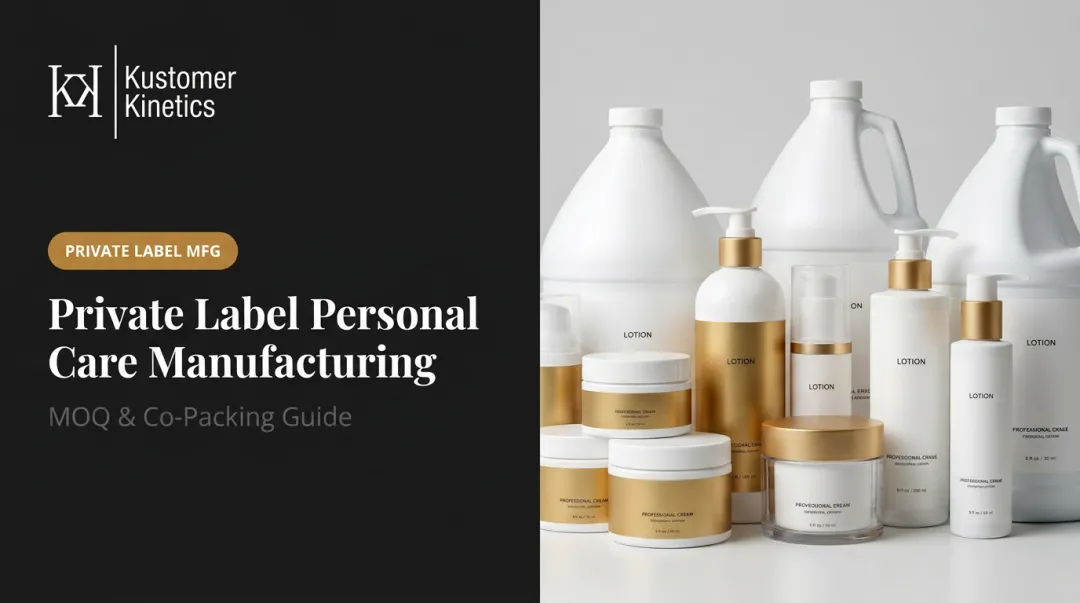
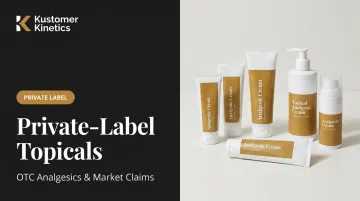
Private-label topicals are manufactured by a third party and sold under another brand's name. For practitioners, this means a physical therapy clinic or massage practice can offer a branded pain relief cream without owning a manufacturing facility. The product comes from a contract manufacturer; the label and the client relationship belong to the practitioner.
The OTC distinction matters here. Unlike prescription topicals, OTC analgesics don't require a physician's order — but they are regulated drugs, not cosmetics.
They fall under the FDA's OTC monograph system, which sets firm rules about active ingredients, concentrations, and labeling language.
Common product forms in the private-label analgesic market include:
- Creams and lotions
- Gels (cooling, analgesic, and anesthetic)
- Hydrogels
- Patches
Across all these forms, the same active ingredients appear: menthol, methyl salicylate, lidocaine, and capsaicin. Concentrations and formulation quality, though, vary widely. A premium price point doesn't automatically mean better formulation or stronger regulatory compliance — that depends on the manufacturer's standards and documentation.
The FDA OTC Monograph System: The Regulatory Foundation
What the Monograph System Does
The FDA's OTC monograph system pre-approves certain active ingredients, their permitted concentration ranges, and the conditions under which they can be marketed — without requiring each product to go through a full New Drug Application (NDA). For topical analgesics, the governing document is OTC Monograph M017: External Analgesic Drug Products for Over-the-Counter Human Use (Final Administrative Order OTC000033), deemed effective March 27, 2020 and posted May 2, 2023.
Monograph compliance in practice means:
- Active ingredients and concentrations match M017's permitted ranges
- Label language follows FDA-prescribed formats (Drug Facts panel)
- Manufacturing follows current Good Manufacturing Practices (cGMP)
What the 2020 CARES Act Changed
The Over-the-Counter Monograph Safety and Innovation Act — passed as part of the CARES Act — replaced the old rulemaking process with an administrative order system. The FDA can now issue, revise, or update monographs through administrative orders, moving faster than the previous notice-and-comment rulemaking process allowed.
This change also introduced the OTC Monograph User Fee Program (OMUFA). Manufacturers engaging in monograph drug activities now pay facility fees — FY 2026 rates run approximately $19,188 for Monograph Drug Facilities. That figure alone signals that OTC monograph manufacturing carries real regulatory overhead, not a paperwork formality.
When Products Fall Outside the Monograph
A product becomes a "new drug" under FDA law — and legally requires an NDA — if it:
- Uses an active ingredient not listed in M017
- Exceeds permitted concentration ranges
- Makes claims beyond the monograph's defined scope
The FDA has issued warning letters for this violation: topical products with 5% lidocaine (above M017's 0.5–4% range) were classified as unapproved new drugs. Sourcing such a product — even unknowingly — creates real liability for practitioners.
How Market Claims Are Categorized for Topical Products
Cosmetic vs. Drug: The Claims Determine the Category
A product's regulatory category is determined by its intended use, which the FDA evaluates through label claims, advertising, websites, and even the known therapeutic use of certain ingredients.
| Claim Type | Example Language | Regulatory Category |
|---|---|---|
| OTC Drug Claim | "Temporarily relieves minor muscle pain" | Drug — requires monograph compliance |
| OTC Drug Claim | "Numbs skin for temporary pain relief" | Drug — requires monograph compliance |
| Cosmetic Claim | "Soothes tired muscles after activity" | Cosmetic — no drug approval required |
| Cosmetic Claim | "Provides a warming sensation" | Cosmetic — if no treatment implied |
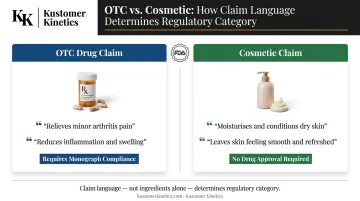
The line blurs when language implies biological change or therapeutic action. Claims like "restores joint mobility" or "repairs tissue" push a product into drug territory — and without monograph compliance or NDA approval, those claims are unlawful.
Red Flags in Private-Label Analgesic Marketing
Watch for these patterns when evaluating private-label suppliers:
- "Prescription-strength" language on an OTC label is legally meaningless and practically misleading
- Undisclosed active ingredient concentrations hiding behind "proprietary blend" language — a compliance red flag, not a competitive advantage
- Brand names engineered to sound pharmaceutical without any supporting documentation or approval
- Structure/function claims ("rebuilds cartilage," "regenerates nerve tissue") that require drug approval or monograph backing the product doesn't have
For OTC analgesics, the primary substantiation mechanism is monograph compliance itself. That means the active ingredient appears on the approved list and its concentration falls within the permitted range. Consumer perception claims ("9 out of 10 users felt relief") can supplement that foundation — but they can't replace it.
Common Active Ingredients in OTC Topical Analgesics
FDA-Permitted Categories and Concentration Ranges
M017 establishes three primary categories of active ingredients for OTC topical analgesics. All concentration data below comes directly from OTC Monograph M017:
Counterirritants (cooling, heating, or redness-producing agents):
- Menthol: 1.25% to 16%
- Camphor: 3% to 11%
- Methyl salicylate: 10% to 60%
- Capsaicin: 0.025% to 0.25%
Local anesthetics:
- Lidocaine: 0.5% to 4%
- Benzocaine: 5% to 20%
- Pramoxine hydrochloride: 0.5% to 1%
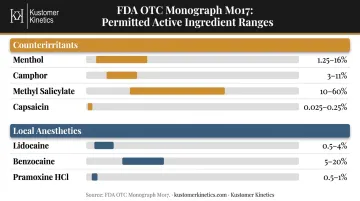
Counterirritants work by triggering cooling or warming nerve responses that temporarily mask pain signals. Local anesthetics block nerve signal transmission at the application site. Both mechanisms provide temporary relief. Neither repairs underlying tissue damage.
Concentration Isn't Everything
Higher concentrations don't automatically mean better outcomes. Exceeding M017's permitted ranges doesn't enhance efficacy — it creates regulatory violations and documented safety risks.
The FDA has issued specific warnings on two fronts:
- Menthol, methyl salicylate, and capsaicin: A September 2012 Drug Safety Communication reported rare but serious first-, second-, and third-degree burns from OTC topical muscle and joint pain relievers.
- Lidocaine above 4%: In March 2024, the FDA warned against OTC products exceeding this threshold, citing risks of irregular heartbeat, seizures, and breathing difficulties.
These safety signals matter directly for private-label formulation decisions. Kustomer Kinetics' Pain Blocker lotion uses 15% methyl salicylate and 10% menthol — both within M017's permitted counterirritant ranges. For brands developing a private-label analgesic, staying inside those windows isn't just a compliance requirement; it's the credibility floor that separates a defensible market claim from a liability.
What Makes a High-Quality Private-Label Topical
Formulation Integrity
A high-quality private-label OTC analgesic starts with:
- Active ingredient concentrations must hit monograph-compliant ranges — not inflated to sound impressive, not underdosed to cut costs while still claiming drug-category status
- A well-designed vehicle (cream, gel, lotion, hydrogel) that supports ingredient delivery, skin absorption, and appropriate texture for clinical use
- Excipient quality — the inactive base (emollients, stabilizers, humectants) governs skin feel, shelf stability, and whether the finished product holds up to professional use or feels like a commodity drugstore item
Formulation quality only holds when the facility producing it meets drug manufacturing standards — not cosmetic blending ones.
Manufacturing and Documentation Standards
Any private-label manufacturer producing OTC drug products should be evaluated against these baseline requirements:
- FDA facility registration under 21 CFR Part 207 — domestic manufacturers must register within 5 calendar days of beginning manufacture
- cGMP compliance under 21 CFR Parts 210 and 211 — these are drug manufacturing standards, not cosmetic blending standards
- Certificates of Analysis (CoAs) for each batch, confirming active ingredient identity and concentration
- Batch production and control records as required under 21 CFR 211.188
- Finished product release testing confirming active ingredient strength before distribution (21 CFR 211.165)
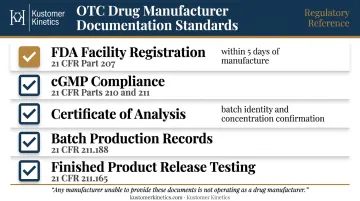
A manufacturer that can't produce these documents on request is not operating as a drug manufacturer — regardless of what their label claims.
Labeling Compliance
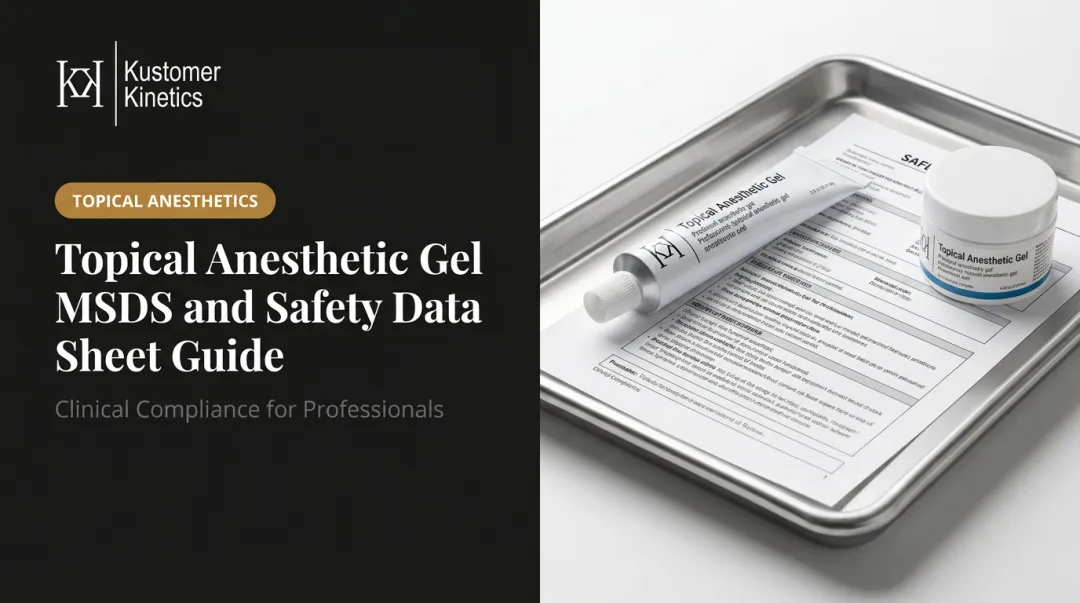
Proper OTC analgesic labeling requires a Drug Facts panel in FDA-prescribed format: active ingredients with concentrations, indications, directions, warnings, and inactive ingredients. A manufacturer producing compliant labels demonstrates they understand the regulatory framework.
One that doesn't — or uses cosmetic-style packaging for a product making drug claims — is creating liability for every practitioner who puts their name on that product.
Kustomer Kinetics' private-label program is built around these same standards — covering formulation, fill, labeling, and packaging for clinic chains, healthcare brands, and distributors in physical therapy, chiropractic, sports recovery, and massage therapy settings.
A Practitioner's Framework for Evaluating Private-Label Products
Before signing on with any private-label topical manufacturer, work through these questions:
Regulatory Compliance
- Can the manufacturer show FDA facility registration documentation?
- Do they operate under 21 CFR Parts 210/211 cGMP standards?
- Can they provide CoAs and batch records for their analgesic formulations?
Formulation Verification
- Do the active ingredient concentrations appear on the label and fall within OTC Monograph M017's permitted ranges?
- Does the label include a Drug Facts panel in the required FDA format?
- Are there drug claims (pain relief, numbing, anti-inflammatory) without clear monograph backing?
Claims Review
- Cross-reference the product's label and marketing materials against M017's approved indications.
- If a product makes treatment claims but won't disclose active ingredient concentrations, that is a compliance gap, not a proprietary formulation secret.
Cost vs. Value
Evaluate cost against documented manufacturing standards, not marketing language. Price alone tells you nothing about formulation quality or regulatory standing.
Before committing to a supplier, request the CoAs, batch records, and facility registration — any manufacturer operating at a professional standard should provide these without hesitation.
Frequently Asked Questions
What are examples of private-label brands?
Terocin, Dendracin Neurodendraxcin, and LidoPro are examples of OTC topical analgesic brands where a product is manufactured by one company and sold under a distinct brand name. Private-label means the formulating manufacturer and the selling brand are different entities. Quality and monograph compliance vary significantly across these products.
What is the FDA OTC monograph system for topical analgesics?
The monograph system is a pre-approval framework that defines which active ingredients, concentration ranges, and label claims are permitted for OTC topical pain relief products. It eliminates the need for a separate drug approval process for each product. The current governing document for external topical analgesics is M017 (Final Administrative Order OTC000033).
What active ingredients are allowed in OTC topical analgesic products?
M017 defines permitted categories and concentration ranges, including:
- Counterirritants: menthol 1.25–16%, camphor 3–11%, methyl salicylate 10–60%, capsaicin 0.025–0.25%
- Local anesthetics: lidocaine 0.5–4%, benzocaine 5–20%, and select others
Using any ingredient outside these parameters — or above the permitted ceiling — creates an unapproved new drug.
What is the difference between a cosmetic claim and an OTC drug claim?
OTC drug claims reference treatment or relief of a condition ("temporarily relieves minor muscle pain"), while cosmetic claims relate to sensation or appearance without implying treatment ("soothes tired muscles after a workout"). A product's label claims determine its regulatory category — not its ingredients alone.
Can practitioners use private-label topicals in their clinical practice?
Yes, practitioners can use and recommend private-label OTC topical analgesics. Before incorporating any product, confirm monograph compliance, cGMP manufacturing, and a proper Drug Facts label. Using a non-compliant product in a clinical setting creates professional and legal exposure.
How can I tell if a private-label topical analgesic is FDA-compliant?
Check for a Drug Facts panel on the label, verify that active ingredients and concentrations fall within M017's permitted ranges, and request the manufacturer's FDA facility registration and cGMP compliance documentation. A legitimate OTC drug manufacturer should provide these without hesitation.