This guide explains how private label personal care manufacturing actually works, what MOQ thresholds mean for practitioners at different business stages, and how to avoid the most common inventory and cost mistakes before you commit to a production run.
Key Takeaways
- Private label uses pre-tested stock formulas you brand as your own — skip the R&D and go straight to selling
- MOQ exists because batch setup costs are fixed, not because manufacturers are padding margins
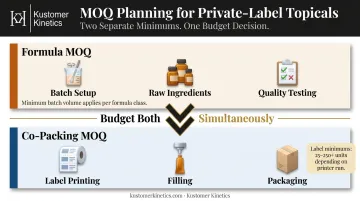
- Co-packing has its own separate MOQ minimums — budget both simultaneously
- Overcommitting on MOQ creates real expiry risk — therapeutic topicals typically carry 18–24 month shelf lives
- Choosing stock formulas and stock packaging delivers the fastest timelines and lowest minimums — custom elements raise both
What Is Private Label Personal Care Manufacturing?
Private label manufacturing means selecting a pre-developed, stability-tested formula from a manufacturer's existing library, applying your own branding, and selling the finished product under your business name. No original formulation required.
According to Covalo's contract manufacturing guide, private label means purchasing pre-existing formulations that are ready to sell — the manufacturer already owns and maintains the formula. Your contribution is the brand identity, not the chemistry.
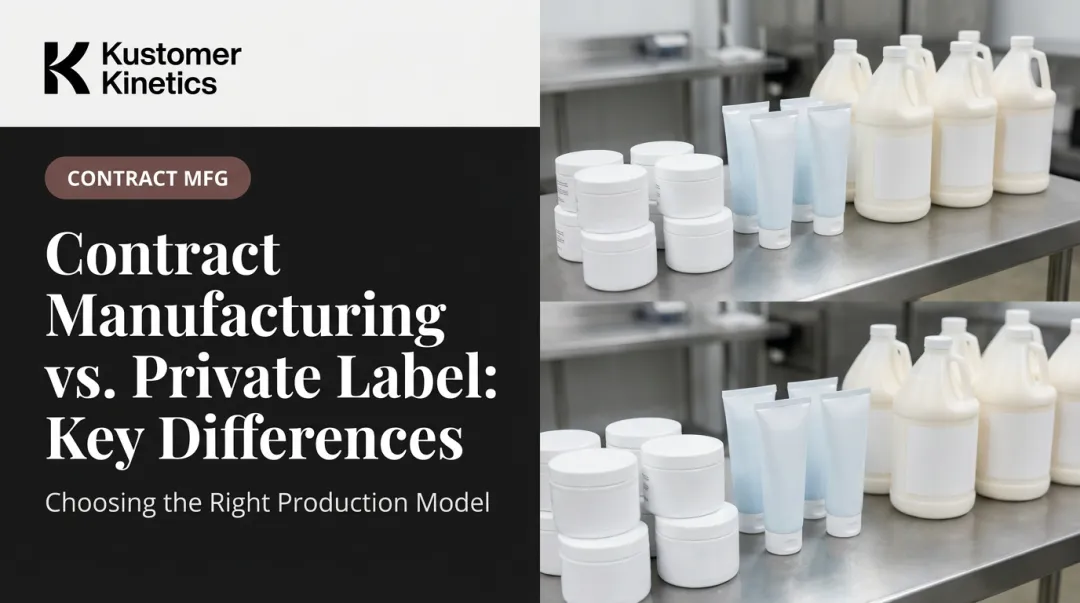
Private Label vs. Contract Manufacturing
These two models get confused constantly, and the distinction affects both your budget and your timeline.
| Private Label | Contract (OEM) Manufacturing | |
|---|---|---|
| Formula source | Manufacturer's existing library | Custom-developed to your spec |
| Timeline | Faster (weeks) | Longer (months) |
| MOQ | Lower | Higher |
| Formula ownership | Manufacturer retains | You own the formula |
| Best for | Practitioners entering branded products | Brands requiring proprietary formulas |
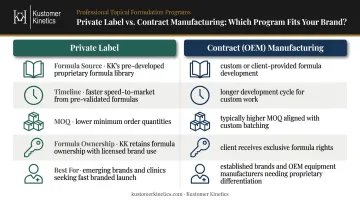
Most practitioners — a massage therapist adding their name to a deep tissue wax, or a physical therapist offering a branded recovery gel — start with private label. Custom contract manufacturing becomes the right call later, once your order volume and need for a proprietary formula make the longer timeline and higher MOQ worthwhile.
What Is Co-Packing?
Co-packing (contract packaging) is the physical execution side of private label. The co-packer handles production execution — not formula ownership or ingredient sourcing. Specifically, that means:
- Filling containers with finished product
- Sealing and capping
- Applying your branded labels
- Final packaging and case assembly
Ryder's co-packaging guide draws a clear line: co-packaging is outsourced packaging, while contract manufacturing involves actual production from raw materials. That distinction matters because co-packing carries its own MOQ thresholds, separate from any formulation minimums.
Why MOQ and Co-Packing Matter for Personal Care Professionals
The Economics Behind MOQ
MOQ (Minimum Order Quantity) exists because manufacturers work in production batches. Machine setup, ingredient procurement, packaging materials, and quality testing represent largely fixed costs per run — producing 100 units requires nearly the same preparation as producing 1,000.
As Covalo explains, MOQ reflects the minimum amount of product a manufacturer needs to produce for a job to be worth its time and effort. It's not a margin strategy. It's batch economics.
Ingredient-level minimums compound this. SBL Comp notes that high-quality professional ingredients are often available only in large bulk volumes — and those supplier-level minimums cascade upward into finished product minimums. A manufacturer who must purchase a minimum quantity of a specialty therapeutic active cannot economically fill a 50-unit order.
The Specific Risk for Practitioners
Committing to a production run that exceeds your realistic sales velocity creates three problems simultaneously:
- Cash flow pressure from capital tied up in unsold inventory
- Storage burden for bulk product in a clinical or studio setting
- Expiry risk — therapeutic topicals typically remain stable for 18–24 months from manufacture under proper storage conditions (per standard shelf-life guidelines for professional topicals), meaning unsold inventory has a countdown
Co-Packing Has Its Own MOQ Layer
This is where practitioners most often underestimate their total commitment. A label printer may require a minimum print run even when your formula MOQ is smaller.
Label minimums across US suppliers range from as few as 25–100 cut-to-size labels (UPrinting, PrintPlace) to 250+ for roll labels. Your co-packer's program minimums for filling and packaging are a separate threshold entirely.
Budget both line items before committing. Getting the formula MOQ right but underestimating labeling minimums — or vice versa — can derail your launch economics before the first unit ships.
For clinical and therapeutic settings, the right manufacturing partner can help align both thresholds. Kustomer Kinetics offers private-label programs across professional-grade topicals — analgesic lotions, cooling gels, ultrasound couplants, and massage waxes — built to clinical performance specifications rather than cosmetic-grade standards.
How Private Label Co-Packing Works: Step-by-Step
The full process runs: formula selection → packaging and label decisions → MOQ agreement → production batch → co-packing/filling → quality check → delivery.
Step 1: Formula and Product Selection
The practitioner reviews the manufacturer's available stock formulations. For professional personal care, this spans creams, gels, lotions, specialty therapeutic topicals, and clinical preparations.
Key questions to ask at this stage:
- What base formulas are available, and have they been stability-tested?
- What active ingredient concentrations are included?
- Are formulations appropriate for my professional application (clinical recovery vs. general massage)?
- What pack sizes are available — dispensing bottles, gallon fills, case quantities?
Kustomer Kinetics' stock formula library, for example, includes:
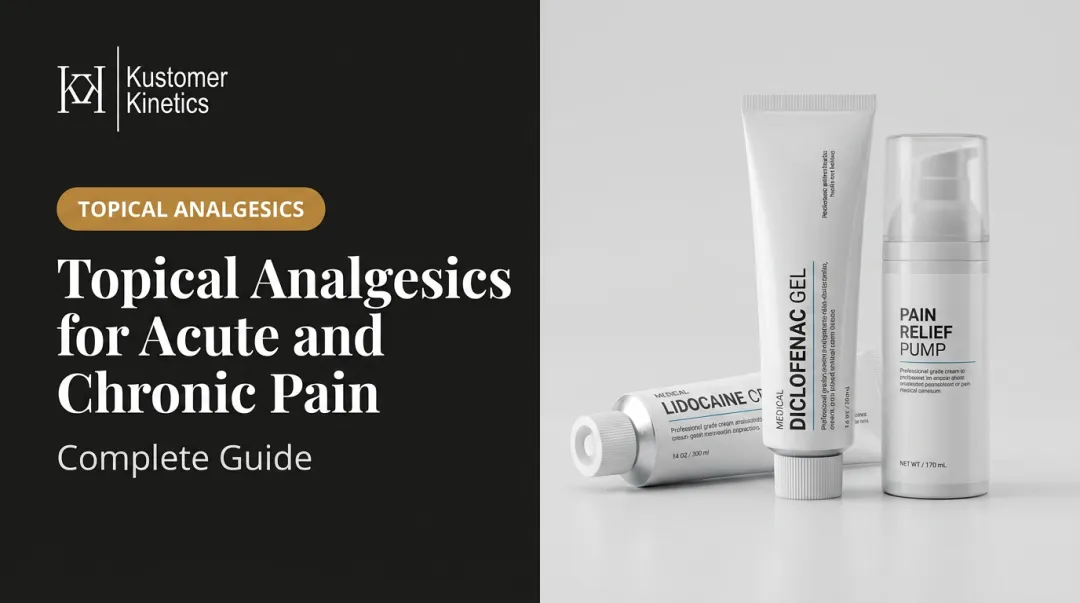
- Pain Blocker analgesic lotion (15% Methyl Salicylate, 10% Menthol)
- Lido Gel topical anesthetic hydrogel (4% Lidocaine)
- Polar Relief cooling gel
- Sonic Scan ultrasound couplant
- Synapse electrode cream
- Soft Touch deep tissue massage wax
- Post-treatment skin conditioners
All are available for private-label branding across clinic-dispensing, gallon, and case pack formats.
Step 2: MOQ, Packaging, and Label Agreement
This is where costs are most commonly underestimated. Two variables drive your actual minimum commitment:
Packaging choice is the single biggest lever:
- Stock containers (standard bottles, jars, dispensing formats) keep MOQ thresholds lower and timelines shorter
- Custom-printed bottles, specialty closures, or imported packaging components raise both MOQ and lead time (often significantly)
Published examples from US private-label programs show stock formula minimums ranging from 100 units (MB Cosmetics Lab) to 250–1,000 units (SBL Comp's Ready-To-Go programs). Custom formula programs start higher. Your actual minimum depends on formulation, packaging format, and the specific manufacturer's program.
Label compliance adds another layer. Under FDA cosmetic labeling regulations and MoCRA, every label must include an identity statement, accurate net quantity, and manufacturer/distributor name and place of business on the information panel. Ingredients must be listed in descending order of predominance. Confirm before production whether your co-packer provides label review support, as this varies by program.
Step 3: Production, Co-Packing, and Delivery
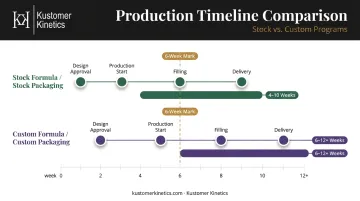
The manufacturer produces the batch, fills into agreed containers, applies brand labels, and prepares finished units for delivery. Published lead times for US private-label co-packing programs:
- Stock formula / stock packaging: 4–6 weeks (FormuNova) to 4–10 weeks (SBL Comp) after design approvals are finalized
- Custom formulation / custom packaging: 6–12 weeks or longer, depending on complexity
Once production is complete, request standard quality documentation before accepting delivery:
- Batch consistency records
- Fill weight accuracy confirmation
- Label placement review
- Certificate of Analysis (CoA) — not universally required under current FDA cosmetic GMP guidance, but standard practice among professional-grade manufacturers
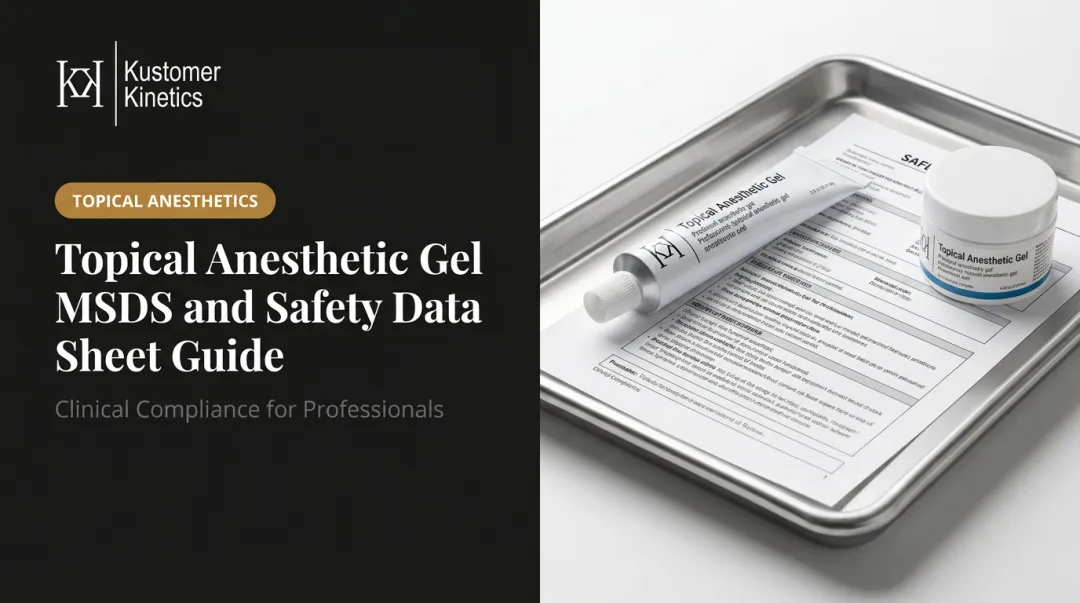
Kustomer Kinetics provides MSDS documentation for all product lines and manufactures under cGMP-aligned topical formulation practices at its Arcadia, California facility.
Key Factors That Affect MOQ in Professional Personal Care
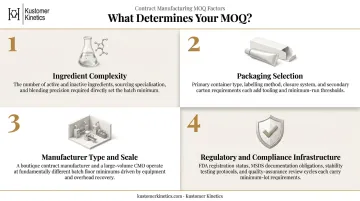
Four variables determine where your actual production minimum lands:
1. Ingredient complexity Specialized therapeutic actives — high-concentration analgesics, clinical hydrogel components, conductive electrode formulations — carry supplier-level MOQs that flow into finished product minimums. Simpler formulations generally support lower minimums.
2. Packaging selection Stock containers = lower MOQ, shorter timeline. Custom formats raise both. This is the variable practitioners most directly control. Evaluate this honestly before requesting a quote.
3. Manufacturer type and scale Smaller specialty manufacturers focused on professional and clinical personal care categories often support lower MOQs than high-volume cosmetic contract facilities built for retail-scale brands. Match the manufacturer to your product category and order scale, not just to the lowest price quote.
4. Regulatory and compliance infrastructure Under MoCRA, the "responsible person" (the manufacturer, packer, or distributor whose name appears on the label) must register facilities and list each marketed cosmetic product with the FDA.
For clinical and professional use contexts, confirming your manufacturer operates with FDA facility registration and GMP-aligned practices isn't optional. It affects what documentation accompanies each batch and whether your product can legitimately operate in a clinical setting.
Common Misconceptions About Private Label and Co-Packing
"MOQ is just a manufacturer markup." It isn't. Batch setup costs, ingredient procurement minimums, and packaging supplier requirements are the structural drivers. Reducing MOQ below viable batch thresholds costs the manufacturer more than it saves you. Very low-MOQ programs exist, but they're built around stock formulas and stock packaging — specifically designed for that constraint.
"Co-packing and contract manufacturing are the same thing." They aren't. Co-packing is filling and packaging execution for an already-determined formula. Contract manufacturing involves developing and owning the formula itself. Beauty Independent notes that stock formula IP typically remains with the manufacturer — you're licensing the formula for your brand, not acquiring it.
Beyond terminology, knowing when private label actually fits your situation matters just as much. Consider a different approach when:
- You need a genuinely proprietary formula — a unique therapeutic blend, a specific active concentration, or a product supporting a clinical claim — custom contract manufacturing is the right model, with higher MOQs and longer development timelines
- You're a solo practitioner or very small clinic with limited client volume — purchasing wholesale professional-grade product is often more practical than committing to private label minimums
Private label makes the most sense when brand identity and repeat client purchasing justify the inventory commitment.
Frequently Asked Questions
Is private label skin care profitable?
Profitability depends on retail pricing strategy, MOQ management, and sales volume. Practitioners selling direct to clients can achieve strong margins, but only when MOQ commitments align with realistic sales velocity. Overcommitting on a first run is the fastest way to erode margins.
Is contract manufacturing the same as private label?
No. Private label uses a manufacturer's pre-developed formulas with your branding applied. Contract manufacturing builds a custom formula to your specifications — different cost structures, timelines, MOQ thresholds, and formula ownership terms apply to each model.
What is a personal care contract manufacturer?
A licensed facility that produces finished personal care products — creams, gels, lotions — on behalf of a brand, using either stock formulas (private label) or custom-developed formulations (contract/OEM manufacturing). Some facilities, like Kustomer Kinetics, operate across both models for professional and clinical topicals.
What is co-packing in personal care manufacturing?
Co-packing is the process of filling, labeling, and packaging a personal care product on behalf of a brand. The co-packer handles physical production execution, not formula development, and operates under its own separate MOQ requirements from the formulation minimum.
What is a typical MOQ for private label personal care products?
Stock formula programs in the US generally start at 100–1,000 units depending on the supplier and product type. Custom formula programs typically require higher minimums. Packaging choice — stock versus custom — is the biggest variable determining where your actual minimum lands.
How long does private label co-packing typically take?
Stock formula and stock packaging programs typically run 4–10 weeks from order confirmation to delivery. Custom formulation or custom packaging extends that to 6–12 weeks or longer. Finalized artwork and label approvals are usually the biggest bottleneck in stock formula programs.