Ultrasound gel is an acoustic couplant: a water-based medium designed to eliminate the air gap between the transducer and skin. Without it, sound waves would bounce off the air layer rather than penetrating tissue. This article covers exactly what's in ultrasound gel, the physics behind why it works, the different types available, and what clinicians and patients should know about its safety.
Key Takeaways
- Ultrasound gel is primarily water (often >95% by weight), thickened with carbomer and stabilized with humectants, preservatives, and pH adjusters
- Air reflects 99.9% of ultrasound energy; gel eliminates that gap so sound waves reach target tissue
- Three main types exist: standard non-sterile, sterile single-use, and therapeutic-grade couplant
- Uses span diagnostic imaging, physical therapy, MSK assessment, and ultrasound-guided procedures
- Allergic reactions are rare, most often tied to preservatives or propylene glycol
What Is Ultrasound Gel Made Of?
Ultrasound gel is a water-dominant hydrogel. Each ingredient serves a specific acoustic or clinical function.
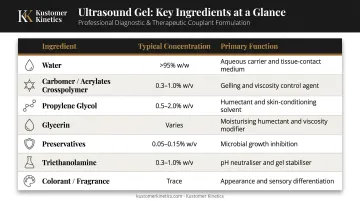
Here's a quick reference before the breakdown:
| Ingredient | Typical Concentration | Primary Function |
|---|---|---|
| Water | >95% w/w | Acoustic transmission medium |
| Carbomer / acrylates crosspolymer | 0.3–1.0% w/v | Gelling agent; viscosity control |
| Propylene glycol | 0.5–2.0% w/v | Viscosity; moisture retention |
| Glycerin | Varies | Humectant; slows evaporation |
| Preservatives (e.g., MCI/MI) | 0.05–0.15% w/v | Microbial contamination control |
| Triethanolamine | 0.3–1.0% w/v | pH adjustment; neutralizes carbomer |
| Colorant / fragrance | Trace or absent | Identification; generally avoided |
Water
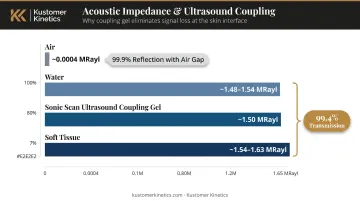
Water is the foundation of every standard ultrasound gel formulation. Aurora's Clarity Ultrasound Gel SDS lists water at >95% by weight, and FDA 510(k) filing K130581 uses deionized water as the base carrier, adjusted to 100% by weight. Water's acoustic impedance (~1.48–1.54 MRayl) closely matches soft tissue (~1.54–1.63 MRayl), which is precisely what makes gel an effective transmission medium.
Thickening and Gelling Agents
Pure water won't stay on skin long enough to complete a scan. Carbomer (carbopol) is the most common gelling agent in medical-grade formulations — FDA 510(k) K130581 lists carbomer/acrylates crosspolymer at 0.3–1.0% w/v. It works by forming a cross-linked polymer network that transforms water into a stable gel with controlled viscosity.
Propylene glycol is frequently added alongside carbomer — listed at 0.5–2.0% w/v in the same filing — contributing to both viscosity and moisture retention.
Humectants
Humectants like glycerin slow evaporation during longer procedures. This matters clinically: a gel that dries mid-scan creates micro air pockets that degrade image quality.
Preservatives
Multi-dose bottles in clinic environments are susceptible to contamination. Preservatives found in ultrasound gels include:
- Methylchloroisothiazolinone/methylisothiazolinone (listed at 0.05–0.15% w/v in FDA K130581)
- Methylparaben (used at 0.20% in a 2022 peer-reviewed formulation study)
- Phenoxyethanol (documented in a 2019 Contact Dermatitis case report involving ultrasound gel)
Sterile single-use sachets may rely on sealed packaging instead of chemical preservatives — confirm on a product-by-product basis.
pH Adjusters
FDA K130581 specifies a gel pH range of 6.5–7.5, with triethanolamine at 0.3–1.0% w/v used to neutralize the carbomer and stabilize the formula. Parker's Aquasonic Clear SDS confirms a similar range of 6.5–7.0. Keeping pH close to that of skin reduces the risk of irritation and prevents probe material degradation over time.
Colorants and Fragrance
Some commercial gels include a blue colorant for easy identification and post-scan cleanup. Fragrance is generally avoided in medical-grade formulations — fragrance allergy affects roughly 1% of adults and involves delayed type IV hypersensitivity, making it a real sensitization risk in repeated clinical use.
How Does Ultrasound Gel Work?
Ultrasound gel works by solving an acoustic impedance problem — specifically, the mismatch between the transducer and skin that air causes.
When a sound wave crosses from one medium to another with a very different impedance, most of its energy reflects back rather than passing through. A medical ultrasound physics textbook puts the air/soft-tissue reflection coefficient at 0.999, meaning 99.9% of ultrasound energy bounces off an air interface without penetrating the body at all.
Gel solves this by replacing the air gap with a medium whose impedance bridges the transducer and skin:
| Medium | Acoustic Impedance (MRayl) |
|---|---|
| Air | ~0.0004 |
| Water | ~1.48–1.54 |
| Commercial ultrasound gel | ~1.5 |
| Soft tissue | ~1.54–1.63 |
A 2022 formulation study reported gel-to-skin reflection at just 0.6%, with transmission at 99.4% — a near-complete reversal of what happens with air.
Matching impedance alone isn't enough — the gel's viscosity determines whether that acoustic bridge holds throughout the scan. Getting this balance right requires three things:
- Body-stable thickness to fill micro-surface irregularities and prevent air pockets from skin texture
- Even spreadability so the gel distributes uniformly without trapping bubbles during application
- Probe-surface adhesion so the gel stays in contact with the transducer under light pressure, not running off mid-scan
A gel too thin runs off the probe surface before imaging begins. One too thick traps air during spreading, reintroducing exactly the problem it was meant to eliminate.
Types of Ultrasound Gel
Standard Non-Sterile Multi-Use Gel
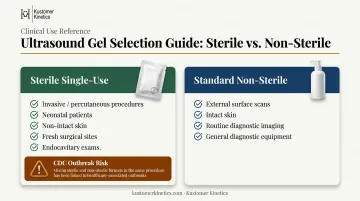
This is the most common type in general diagnostic imaging — dispensed from large bottles, cost-effective, and appropriate for external surface scans on intact skin. It is not appropriate for procedures near open wounds, non-intact skin, or any invasive application.
Kustomer Kinetics' Sonic-Scan™ Ultrasound Scanning Couplant Gel falls into this category. It's formulated specifically for diagnostic imaging in hospitals, imaging centers, OB/GYN practices, cardiology departments, and physical therapy and chiropractic clinics across the US. Available in 16 oz, gallon, and 4-gallon case quantities, it's designed for transducer-to-skin transmission across standard diagnostic ultrasound equipment.
Sterile Single-Use Gel
Packaged in sealed single-dose sachets, this type is required when infection risk is elevated. The CDC specifies that only sterile single-use gel should be used before or during percutaneous procedures, including IV line placement. AIUM's 2023 guidelines expand that list further.
Sterile or bacteriostatic gel is required for:
- Invasive procedures and percutaneous access
- Neonatal patients
- Non-intact or compromised skin
- Areas near fresh surgical sites
- Endocavitary exams on intact mucous membranes
Multiple healthcare outbreaks have been traced to contaminated non-sterile gel used in settings where sterile formats were required. Choosing the wrong format in these settings is an infection-control failure — not a minor product substitution.
Therapeutic-Grade Ultrasound Couplant
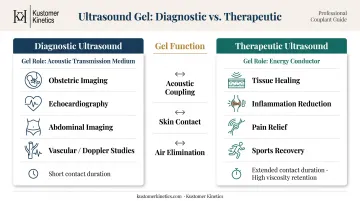
Physical therapy and clinical recovery applications involve longer continuous contact times than a typical diagnostic scan. Therapeutic gels must maintain consistent acoustic coupling throughout an entire session. If the gel dries or thins mid-treatment, energy delivery to the target tissue becomes inconsistent — which directly affects treatment outcomes.
Key requirements for therapeutic-grade couplant:
- Stays viscous and conductive across extended treatment durations
- Compatible with therapeutic ultrasound frequencies (1 MHz and 3 MHz)
- Non-irritating for repeated skin contact in ongoing treatment plans
Kustomer Kinetics' Ultra Gel™ Ultrasound Couplant is purpose-formulated for physical therapy, chiropractic, sports recovery, and rehabilitation settings. It's built for therapeutic ultrasound modalities and available in bulk gallon and case quantities suited for high-volume clinical dispensing.
Common Uses of Ultrasound Gel
Medical Diagnostic Imaging
Gel is essential for every surface-probe diagnostic ultrasound application:
- Obstetric/prenatal imaging — viewing the fetus, placenta, and amniotic fluid; a 2013 US study reported pregnancies receiving approximately 4–5 obstetric ultrasounds on average
- Echocardiography — assessing heart structure and function; roughly 34 million echocardiography procedures were performed on Medicare beneficiaries between 2007 and 2011
- Abdominal imaging — liver, kidneys, gallbladder, and pancreas
- Vascular/Doppler studies — Medicare vascular ultrasound claims grew from 4.4 million in 1998 to 8.6 million in 2013
Musculoskeletal and Physical Therapy Uses
MSK ultrasound uses gel to visualize muscles, tendons, ligaments, and joints in real time. The AIUM MSK practice parameter covers joint/synovium, bones, muscles, tendons and sheaths, ligaments, and fascia as components of a complete exam — all requiring surface-probe gel coupling.
This modality is routine in sports medicine and physical therapy clinics for diagnosing tears, tendinopathies, bursitis, and nerve entrapments.
Therapeutic ultrasound shifts the role of gel from imaging aid to energy conductor. Where MSK imaging focuses on diagnosis, therapeutic ultrasound uses sound waves to promote tissue healing, reduce inflammation, and relieve pain. A Journal of Ultrasound in Medicine review notes that clinicians apply a handheld transducer with coupling gel and move it over the injured area — making gel quality and longevity more critical here than in a brief diagnostic scan.
Guided Procedures
Ultrasound-guided interventions — nerve blocks, biopsies, PICC line placement, vascular access — rely on gel to maintain real-time imaging clarity while the clinician works. In these settings, gel choice directly affects patient safety, which is why the CDC specifies sterile single-use formats for percutaneous procedures.
Is Ultrasound Gel Safe?
Professional ultrasound gels are formulated to be non-toxic and appropriate for repeated skin contact. They don't absorb into the skin in clinically meaningful amounts during routine topical use.
Allergic Reactions
Allergic contact dermatitis from ultrasound gels is rare. According to a study published in Reumatología Clínica, reactions have mainly been associated with propylene glycol and preservative allergens. A 2019 Contact Dermatitis case report documented contact urticaria caused by phenoxyethanol specifically. Symptoms typically include localized redness, itching, or mild dermatitis at the application site.
Patients with known chemical sensitivities should inform their sonographer before a scan. Paraben-free and propylene glycol-free formulations are available for sensitive patients.
Infection Control
Beyond ingredient sensitivities, contamination is the other major risk. The CDC has documented multiple healthcare outbreaks traced to contaminated non-sterile gel. Best practices include:
- Never top off multi-dose bottles (introduces contamination)
- Use sterile single-use formats for any invasive or percutaneous procedure
- Discard opened bottles per facility policy
- Store gel per manufacturer recommendations to prevent degradation
Gel Temperature and Patient Comfort
A 2017 ED trial (the HUGS Trial) compared heated gel at 102°F against room temperature gel at 82.3°F. The satisfaction score difference was just 3.7 points on a 100mm scale — a statistically modest gap. Warming gel is a reasonable comfort step, but clinicians shouldn't expect it to substantially change patient satisfaction scores.
Frequently Asked Questions
Is it possible to be allergic to ultrasound gel?
Yes, though it's uncommon. Reactions are most often linked to preservatives (parabens, isothiazolinones, phenoxyethanol) or propylene glycol. Patients with known skin sensitivities should inform their sonographer, since alternative formulations (paraben-free or propylene glycol-free) are available.
What is the difference between ultrasound gel and regular lotion or lubricant?
Ultrasound gel is specifically formulated to match the acoustic impedance of soft tissue so sound waves transmit with minimal energy loss. Standard lotions, moisturizers, and generic lubricants are not engineered for this purpose and can degrade image quality or, in some cases, be incompatible with probe materials.
Does ultrasound gel expire or go bad?
Yes. Shelf life typically ranges from 1 to 5 years depending on formulation, but opened multi-dose bottles are susceptible to microbial contamination. Discard them according to your facility's policy regardless of the printed expiration date.
Is ultrasound gel safe during pregnancy?
Standard ultrasound gel is routinely used throughout prenatal care and is considered safe for topical application. A 2017 pilot study did identify gel as a potential source of phthalate and phenol exposure, so patients with known ingredient sensitivities should mention this to their provider.
Can the same gel be used for both diagnostic and therapeutic ultrasound?
Some multi-purpose gels cover both applications, but therapeutic sessions run longer than diagnostic scans — a standard diagnostic gel can dry out mid-treatment. Purpose-formulated couplants like Kustomer Kinetics' Ultra Gel™ are designed to maintain conductivity throughout extended sessions.
What should you do if ultrasound gel gets on clothing?
Most ultrasound gels are water-based and non-staining. Blotting promptly and rinsing with water removes the gel cleanly. Colored gel formulations may leave a faint residue on certain fabrics, so checking the specific gel type used is a good precaution.