For RF treatments, a conductive medium isn't optional. When an RF handpiece contacts dry skin, it only touches the surface high points, leaving microscopic air pockets that cause uneven energy delivery — and uneven energy delivery means inconsistent skin tightening, potential hotspots, and patient discomfort. A conductive gel fills that micro-topography and creates uniform electrode contact.
According to a 2020 aesthetic RF review published in PMC, RF energy converts to thermal energy through tissue resistance — current, resistance, and time. The gel you choose controls one side of that equation. This article breaks down which gel types work best for RF, how they compare on the criteria that matter in a clinical setting, and how to make the right call for your practice.
Key Takeaways
- Standard ultrasound gel is the safest, most cross-compatible option for RF and most common in professional settings
- RF-specific cooling gels offer good thermal coupling but cost more and limit cross-technology flexibility
- Vegetable glycerin lasts longer on skin than ultrasound gel but gets sticky and can complicate multi-modality protocols
- Aloe vera gel dries too fast under RF heat — acceptable as a one-time substitute, not a standing protocol
- Professional-grade multi-modal couplants deliver the best session stability and cross-modality performance
Why Conductive Gel Is Non-Negotiable for RF Treatments
RF energy works by driving electromagnetic current through tissue, where resistance converts it to heat. That heat stimulates collagen and elastin remodeling in the dermis. The entire mechanism depends on clean, consistent electrical contact between the device electrode and the skin.
Solta's 2021 Thermage CPT Technical User's Manual is explicit: no material other than the approved coupling fluid should sit between the treatment tip and the patient's skin. It should be applied generously to a small section and reapplied throughout treatment — because inadequate contact means inconsistent energy delivery and uneven results.
What Distinguishes a Conductive Gel from Regular Skincare Products
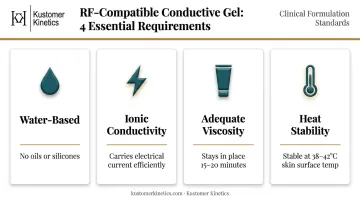
Standard skincare products — serums, moisturizers, facial oils — fail RF requirements on at least one of the following criteria:
- Must be water-based — oils and silicones are electrical insulators that block RF energy entirely
- Must have ionic conductivity (the ability to carry electrical current efficiently) across the electrode-skin interface
- Must be viscous enough to stay in place for 15–20 minutes without running off or drying out
- Must remain stable under heat — RF warms the skin surface to roughly 38–42°C, accelerating evaporation compared to ambient conditions
A product can hydrate skin beautifully and still be completely wrong for RF treatment. When evaluating a gel for clinical use, prioritize electrical performance first — skin compatibility second.
Best Gels for RF Treatment: Top Picks for Professionals
Each gel type below is evaluated on the criteria practitioners care about most: RF conductivity, session stability (how long before reapplication is needed), skin safety, and cross-technology compatibility with modalities like cavitation and EMS.
Standard Ultrasound Gel
Standard ultrasound gel (a viscous, water-based, bacteriostatic gel with a propylene glycol base) is the default conductive medium for most RF, cavitation, EMS, and vacuum therapy treatments. It has an established safety profile with minimal allergy risk and is the most widely stocked option in professional aesthetic settings.
Parker Laboratories' Aquasonic 100 is a widely used benchmark: its current SDS lists viscosity at 130,000–195,000 cps and pH at 6.50–6.95 — formulation characteristics that reflect what a well-performing ultrasound couplant looks like. A 2022 peer-reviewed study reported commercial ultrasound gel conductivity at 0.70 mS at 28°C, providing a useful reference point for its electrical behavior.
Main limitation: It dries quickly under RF heat and needs frequent reapplication. A gel warmer is essential.
| Criterion | Performance |
|---|---|
| RF Conductivity | High — water/propylene glycol base conducts electromagnetic energy efficiently |
| Session Stability | Low-to-moderate — dries under RF heat; reapply every few minutes |
| Cost & Availability | Very economical; 5-liter containers available around $50–$55; widely available through medical supply channels |
RF-Specific Cooling Gel
RF cooling gels are formulated specifically for radiofrequency, microcurrent, and sometimes laser/IPL treatments. Unlike standard ultrasound gel, they're engineered for thermal coupling during RF energy delivery: skin heats up more evenly, and the gel maintains contact longer between reapplications.
They're the right tool when your protocol is RF-focused and you're not combining with high-frequency cavitation in the same session. The tradeoffs are real:
- More expensive per ounce than standard ultrasound gel
- Available primarily through aesthetic supply channels in smaller sizes
- Multiple active ingredients increase sensitization risk — patch testing before full clinical deployment is advisable
- Compatibility with cavitation frequencies has not been confirmed by manufacturers
| Criterion | Performance |
|---|---|
| RF Conductivity | High — formulated specifically for RF and microcurrent; even thermal coupling |
| Session Stability | Moderate — longer-lasting than ultrasound gel under RF heat; reapplication still needed for extended sessions |
| Cost & Availability | Highest cost per ounce of the options reviewed; available through aesthetic supply channels in smaller sizes |
Vegetable Glycerin
Vegetable glycerin is a naturally occurring, water-miscible humectant increasingly used by body contouring practitioners as a cost-effective RF medium. It conducts RF electromagnetic energy well, lasts longer on skin than standard ultrasound gel before drying, and its humectant properties promote smooth gliding.
A 2017 peer-reviewed study on glycerin-water electrical properties supports its electrical behavior, though that research studied microwave tomography coupling rather than RF aesthetic applications specifically.
Where it falls short: The sticky texture creates friction with vacuum therapy applicators, making it a poor choice for suction-based treatments. If your protocol combines RF with high-frequency ultrasound cavitation in the same session, check compatibility with your device manufacturer before using glycerin — its acoustic properties at higher ultrasound frequencies may not match standard couplant specifications.
USP vegetable glycerin in gallon size runs approximately $0.58–$0.60 per ounce, making it one of the more budget-friendly options.
| Criterion | Performance |
|---|---|
| RF Conductivity | High — conducts RF electromagnetic energy well; acoustic compatibility at high cavitation frequencies should be verified per device |
| Session Stability | Moderate-to-good — outlasts ultrasound gel on skin; reapplication still needed in longer sessions |
| Cost & Availability | Economical; available in gallon sizes (~$99/gallon, ~$0.58/oz); widely available through cosmetic ingredient suppliers |
Professional-Grade Multi-Modal Ultrasound Couplant
Professional-grade multi-modal couplants are engineered for clinical and medspa use, formulated to conduct RF, EMS, microcurrent, and acoustic (ultrasound) energy in a single product. These gels typically combine a water-glycerin or water-glycol base with sufficient ionic content, and the viscosity is calibrated specifically for full treatment sessions without drying or displacement.
The practical difference over standard ultrasound gel shows up mid-session: less reapplication interruption, consistent contact across the treatment zone, and no residue that interferes with electrode contact or degrades handpiece surfaces.
For practitioners running multi-technology platforms (the RF + cavitation + EMS combinations common in 6-in-1 and similar machines), this category is the most practical choice. It eliminates the need to switch products between modalities and reduces the risk of cross-technology incompatibility.
Kustomer Kinetics manufactures Ultra Gel™ (therapeutic ultrasound couplant) and Sonic Scan™ (diagnostic scanning couplant) for clinical settings, with wholesale, bulk gallon, and case pricing available. Private-label and contract manufacturing programs are available for clinic chains and medspa groups — contact us at 626-445-6161 to discuss program specifics.
| Criterion | Performance |
|---|---|
| RF Conductivity | Excellent — formulated for multi-modal compatibility; consistent ionic conductivity across session length |
| Session Stability | High — viscosity engineered to maintain contact for full treatment sessions; fewer reapplication interruptions |
| Cost & Availability | Higher per-ounce than bulk ultrasound gel; available through professional aesthetic supply channels; private-label bulk options available |
Aloe Vera Gel
Pure aloe vera gel can carry RF energy — it's approximately 99% water with sufficient ionic content to conduct electromagnetic current. It's soothing, oil-free, and available everywhere, which is why some practitioners reach for it when standard gel runs out.
The problem is session performance. Aloe dries rapidly on skin under normal conditions, and RF-generated heat accelerates that process significantly. A 2004 PubMed-indexed study found commercial aloe products vary substantially in composition between brands, which compounds the conductivity inconsistency problem.
Reserve it for emergencies only — it lacks the session stability and batch consistency required for reliable clinical protocols.
| Criterion | Performance |
|---|---|
| RF Conductivity | Fair — sufficient to carry RF energy but variable by brand; degrades quickly under RF-generated heat |
| Session Stability | Low — dries before treatment zones are complete; creates discontinuous conductive layer |
| Cost & Availability | Very low cost; retail and grocery channels; no clinical bulk sizes; consistency varies widely |
How to Choose the Right Gel for Your RF Practice
Start With the Non-Negotiables
Oil-free and silicone-free is your baseline — full stop. Oils (coconut, mineral, squalane, any fatty medium) and silicones are electrical insulators. Applying an RF device over an oil-based medium creates uneven energy distribution, increases hotspot risk at higher settings, and produces unreliable outcomes regardless of device power. Any product containing these ingredients is disqualified before anything else gets evaluated.
AORN electrosurgery guidance specifically notes that oils and lotions interfering with electrode contact must be corrected before treatment proceeds — the same principle holds for RF coupling media.
Cross-Technology Compatibility
For most professional settings today, multi-technology compatibility is the deciding factor. Practitioners using 6-in-1 or similar combination platforms need a gel that works across every modality in the same session.
| Gel Type | RF | Cavitation | EMS | Vacuum |
|---|---|---|---|---|
| Standard ultrasound gel | ✓ | ✓ | ✓ | ✓ |
| RF cooling gel | ✓ | Verify with manufacturer | ✓ | ✓ |
| Vegetable glycerin | ✓ | Verify at high frequencies | ✓ | ✗ (sticky) |
| Multi-modal couplant | ✓ | ✓ | ✓ | ✓ |
| Aloe vera gel | Limited | ✗ | Limited | ✗ |
Session Length and Gel Warming
RF heat evaporates water-based media faster than most other aesthetic modalities. For any gel that dries quickly — standard ultrasound gel being the primary example — a gel warmer is essential.
Clinical warmers such as the Parker Thermasonic operate in the 97–109°F (36–43°C) range. Keeping replacement gel at or near skin temperature prevents the temperature drop that extends warm-up time and reduces treatment efficacy.
Sensitization and Skin Safety
Simpler formulations carry lower sensitization risk. Key considerations:
- Standard two-ingredient ultrasound gel (water + propylene glycol) has a well-established safety profile
- Specialty RF cooling gels with multiple active ingredients require patch testing before clinical deployment
- Patch testing is especially important for practices with a sensitive-skin client base
Pro Tips for Applying Gel During RF Treatments
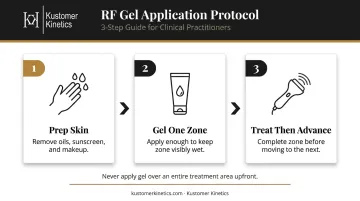
Apply enough to keep the zone visibly wet. A thin film will dry before the handpiece finishes the zone, breaking the conductive pathway and reducing efficacy in the second half of the pass. Under-applying to save product is a false economy.
Gel one zone, treat one zone — then move on. Applying gel across an entire face or body area upfront means the last zone's gel is already compromised by the time the device arrives. Treat zone by zone: apply, complete, advance. Solta's Thermage CPT manual specifies this sequence, and it holds for any RF device.
Sequencing matters on the skin surface, too. Even perfect application technique breaks down if the skin isn't prepped first. Gel applied over residual sunscreen, facial oil, makeup, or silicone-based moisturizer creates an insulating underlayer — and even the most conductive gel can't compensate for a barrier between itself and the skin. Clean, oil-free skin before gel application is non-negotiable for consistent RF outcomes.
Frequently Asked Questions
Can I use ultrasound gel for RF treatment?
Yes — it's the most widely used conductive medium for RF treatments. The water and propylene glycol base conducts RF energy efficiently, protects skin from friction and uneven heating, and is compatible with most complementary technologies including EMS and cavitation.
What is the best conductive gel for RF devices?
It depends on your protocol. Standard ultrasound gel is the safest, most economical all-around option. Professional-grade multi-modal couplants are preferred in clinical and medspa settings for session stability and cross-modality performance. RF-specific cooling gels work well for RF-only protocols but cost more and have unconfirmed cavitation compatibility.
What ingredients should I look for in a conductive gel for RF?
Look for a water base with glycerin or propylene glycol for conductivity and humectancy, plus appropriate viscosity to stay in place during treatment. Avoid anything containing oils, silicones, petrolatum, dimethicone, or alcohol — all of which reduce conductivity or create uneven RF energy delivery.
How often should I reapply gel during an RF treatment?
RF heat evaporates water-based gels quickly — standard formulas need reapplication every few minutes, while higher-viscosity options last longer. Use a gel warmer to keep replacement gel near skin temperature (approximately 97–109°F) and avoid temperature disruption mid-session.
Can I use aloe vera gel as a substitute for RF treatments?
Pure aloe vera conducts RF energy adequately as a one-time substitute, but it dries too quickly under RF-generated heat, creating an unreliable conductive layer mid-session. It's not a professional standard and shouldn't replace a purpose-formulated couplant in regular protocols.
What should I never use as a conductive medium for RF treatments?
Avoid oils (coconut, mineral, squalane), petroleum jelly, silicone-heavy moisturizers, alcohol-based products, and anything containing dimethicone or petrolatum. These materials block energy transfer, create uneven heating, and compromise electrode contact.
Conclusion
Gel selection for RF treatment is a clinical decision that directly shapes outcomes. The wrong medium limits how much energy actually reaches the dermis — and that directly affects treatment consistency, patient comfort, and outcomes.
Evaluate your current gel against these core criteria:
- Water-based and oil-free formulation
- Cross-technology compatible with your treatment platform
- Stable enough to maintain conductivity through a full session
- Simple enough in formulation to minimize sensitization risk
If multi-modality protocols are part of your practice, a professional-grade couplant is the right call over bulk ultrasound gel or improvised alternatives.
Kustomer Kinetics offers professional-grade ultrasound couplants — including wholesale, bulk gallon, and case pricing — with private-label and contract manufacturing options for medspa and clinic chains requiring branded formulations. To explore product options or discuss a custom program, contact the team directly at 626-445-6161 or visit kustomerkinetics.com.