The problem: official infection control guidelines from AIUM, CDC, and UCSF explicitly state that multidose ultrasound gel containers should not be refilled or topped off. Contaminated gel has caused documented outbreaks resulting in hospitalizations and deaths — this isn't a bureaucratic footnote.
This guide explains when gel transfer may be acceptable, what strict hygiene protocols apply, what to never do, and what safer alternatives exist.
Key Takeaways
- AIUM and UCSF guidelines prohibit refilling or topping off multidose gel containers
- If any transfer is done, it must be limited to non-invasive, intact-skin therapeutic settings only
- Never use refilled bottles for invasive procedures, near non-intact skin, or in ICU/sterile environments
- Label every dispensed bottle with a transfer date and discard within 28–30 days
- Single-use, pre-filled dispensing bottles eliminate refilling risk entirely — the safest choice for any clinical setting
Can (and Should) You Refill an Ultrasound Gel Bottle?
The short answer: according to every major medical authority, no.
Three major authorities have weighed in, and their positions are consistent:
- AIUM (2025): Multidose containers "must not be refilled"
- UCSF Infection Control: Containers must not be "refilled or topped off with opened bottles"; bulk gel containers are "strictly prohibited"
- UK Health Security Agency: Only single-use sachets or pre-filled disposable bottles are recommended; reusable bottles and bulk dispensers are not recommended at all
Two Very Different Scenarios
When practitioners ask about "refilling," they usually mean one of two things:
- Transferring fresh gel from a sealed bulk/gallon container into a clean, never-used dispensing bottle — typically for non-invasive therapeutic use
- Adding gel to a previously used bottle that has already been in patient contact (this should never happen under any circumstances)
The second scenario is universally prohibited. The first occupies a gray area, but it still carries real risk.
Why the Risk Is Real
Once a bottle is opened and used clinically, bacteria can enter through the dispensing tip, aerosols, or backflow. A 2022 CDC MMWR report linked contaminated nonsterile multiuse ultrasound gel to a major outbreak with documented outcomes:
- 119 Burkholderia stabilis infections confirmed
- 106 were bloodstream infections
- 14 patients died
A 2025 review identified 111 total ultrasound gel-associated outbreaks, with 65 (58.6%) occurring in ICUs.

These weren't caused by careless topping-off in every case — some involved factory-contaminated product. But the contamination pathway through opened, reused containers is well established.
Where Limited Flexibility Exists
Low-risk, non-invasive settings — therapeutic ultrasound on intact, unbroken skin in a physical therapy or massage therapy context — represent the lowest-risk scenario for gel transfer. Practitioners who use a clean, never-used dispenser bottle filled from a sealed, in-date bulk source may operate within an acceptable risk threshold, provided they follow strict hygiene protocols.
This tolerance applies only in that specific context. The protocols that make it defensible are covered in the steps below.
How to Safely Transfer Ultrasound Gel: Step-by-Step
This section applies only to non-invasive, intact-skin therapeutic applications — such as therapeutic ultrasound for physical therapy or massage therapy. It does not apply to diagnostic imaging, invasive clinical procedures, or any setting where the patient has non-intact skin, mucous membrane involvement, or is immunocompromised.
Step 1: Verify That Transfer Is Permissible for Your Setting
Before anything else, confirm:
- The procedure is non-invasive, on intact, unbroken skin
- No open wounds, mucous membrane contact, or upcoming invasive procedures at the site
- Your facility's infection control policy permits this type of dispensing
- The patient is not immunocompromised, neonatal, or in an ICU-adjacent setting
If any of these conditions are unclear, do not transfer gel — follow your facility's infection-control policy for that procedure.
Step 2: Gather Materials and Prepare Your Workspace
Required materials:
- Sealed bulk source container (in-date, unopened or freshly opened)
- Clean, unused dispensing bottle — never previously used in patient contact
- Disposable gloves
- Disinfectant wipes
- Permanent marker for labeling
- Clean, dry work surface away from any patient-contact area
Wash hands thoroughly before putting on gloves, consistent with CDC hand hygiene guidelines for healthcare workers. Disinfect the work surface before setting anything down.
Then inspect your source container and confirm all of the following:
- Sealed and within its expiration date
- No discoloration, unusual odor, or physical damage
- Not previously stored in a warmer or left open
Step 3: Transfer Gel Without Contaminating Either Container
- Pour or pump gel directly from the bulk container into the clean dispenser bottle
- Keep the source container's nozzle clear of the dispenser bottle opening, your gloves, any surface, and any person
- Do not touch the inside of the dispenser bottle or its opening
- Use a clean, single-use funnel if needed for a no-contact pour
- Fill to a practical volume — do not overfill
- Never mix gel from different batches or add new gel on top of any remaining old gel in a partially used bottle
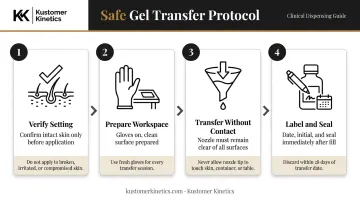
Step 4: Label, Seal, and Prepare for Use
Immediately after filling:
- Label the bottle with the transfer date and expiration — use whichever comes first: the printed expiration on the source container, or one month (28–30 days) from the transfer date
- Seal the bottle tightly and store upright to prevent nozzle contamination
- Store in a clean, dry area away from moisture, heat, and dust
- Wipe the outside of the bottle — including the tip — with a disinfectant wipe before first use and between each patient, allowing full dry time before dispensing
What You Need Before Handling Ultrasound Gel
Required materials at a glance:
- Sealed, in-date bulk gel source appropriate for your application
- A clean, unused dispenser bottle (single-use disposable preferred)
- Disposable gloves
- Disinfectant wipes
- Permanent marker
- Clean, dry work surface
Equipment and Environment Requirements
The workspace must be clean, dry, and separate from any patient-contact area. The dispenser bottle must have no prior patient-contact history — a bottle that was previously used at a treatment table is not suitable as a "fresh" dispenser, regardless of whether it was rinsed or cleaned.
Hygiene and Compliance Readiness
Anyone handling the transfer should have completed basic infection control training. AIUM and CDC recommend that facilities establish written infection control policies that specifically address gel handling and dispensing. If your facility does not have a documented policy, establish one before starting any bulk-to-dispenser transfer.
Common Mistakes When Handling or Refilling Gel Bottles
Most contamination events trace back to a small number of repeated errors in everyday clinical settings. These are the ones to watch for:
- Topping off a partially used bottle. Adding fresh gel to an in-use bottle is one of the most dangerous practices. Bacteria already present contaminate the new gel immediately. Always start with an empty, clean dispenser.
- Allowing tip-to-surface contact. AIUM specifically identifies dispensing tip contact with patients, transducers, or any surface as a contamination event. If the bottle tip touches anything it shouldn't, discard the entire bottle — don't wipe and continue.
- Ignoring the one-month rule. Both UKHSA and University of Toledo policy require opened nonsterile gel bottles to be discarded after one month (or 28 days). Many practitioners use bottles well past this point. Date every bottle on opening, without exception.
- Using the same bottle across procedure types. A bottle suitable for routine therapeutic ultrasound on intact skin is not appropriate for patients with wounds, those scheduled for invasive procedures, or immunocompromised individuals.
Safer Alternatives to Refilling Ultrasound Gel Bottles
For most clinical settings, the safest approach is to avoid in-house gel transfers altogether. Several alternatives eliminate the risk entirely.
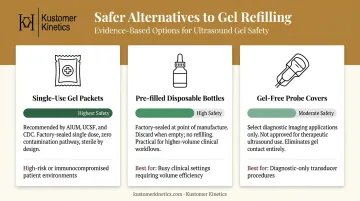
The three main alternatives are:
- Single-use gel packets — each packet opens fresh for one patient, with higher cost per unit and more waste. AIUM, UCSF and CDC guidance covers this format for invasive procedures and vulnerable patient populations.
- Pre-filled disposable bottles — a practical middle ground for higher-volume dispensing. Factory-sealed and discarded when empty, these offer bottle-format convenience without any in-house refilling or transfer risk.
- Gel-free probe covers — available for select diagnostic imaging applications, though not applicable to therapeutic ultrasound workflows.
Kustomer Kinetics manufactures both Ultra Gel Ultrasound Couplant (therapeutic ultrasound for physical therapy, chiropractic, and rehabilitation) and Sonic Scan Ultrasound Scanning Couplant (diagnostic imaging) in formats from 16 oz bottles to gallon jugs and 4-gallon cases.
Clinical dispensing accessories — including refill bottles and pumps — are designed for use with sealed bulk sources. Private-label and clinic-branded dispensing programs are also available. Contact Kustomer Kinetics at 626-445-6161 or kustomerkinetics.com.
Frequently Asked Questions
Can you refill ultrasound gel bottles?
AIUM and UCSF guidelines both state that multidose containers must not be refilled or topped off due to contamination risk. Pre-filled disposable bottles are the recommended alternative. In limited, low-risk non-invasive settings, transferring gel from a sealed bulk source into a clean unused bottle may be acceptable — only when strict hygiene protocols are strictly observed.
How long is ultrasound gel good for once opened?
Opened nonsterile multidose gel containers should be discarded after one month (UKHSA) or 28 days (University of Toledo policy), on the printed expiration date, or sooner if the manufacturer recommends it — whichever comes first. Date every bottle when it is opened.
Is it necessary to wash ultrasound gel off after a procedure?
Gel should be thoroughly removed from the patient's skin after each procedure, and patients should wash the treated area where feasible. Gel left on skin poses a direct contamination risk, particularly for sensitive or compromised skin.
What happens if ultrasound gel becomes contaminated?
Contaminated gel has caused serious healthcare-associated infections, including bacteremia and respiratory infections. The 2022 CDC MMWR outbreak linked contaminated nonsterile multiuse gel to 119 infections and 14 deaths — and such events have occurred in routine clinical settings, not only invasive procedures.
How should an ultrasound gel bottle be stored after opening?
Store upright in a clean, dry area away from heat and moisture. Clean the outside and tip with a disinfectant wipe before and after each use. Keep sealed when not in use. Write the opening date on the bottle and adhere to the 28-to-30-day discard rule.
What type of ultrasound gel should be used for procedures near non-intact skin?
Procedures involving non-intact skin, invasive interventions, mucous membrane contact, or vulnerable populations such as neonates and immunocompromised patients are governed by facility infection-control policy, and nonsterile multidose bottles are not appropriate in those settings regardless of whether they have been refilled. Kustomer Kinetics supplies nonsterile couplants for intact-skin diagnostic and therapeutic use.