The choice matters more than it might seem. It determines how fast you can get to market, how much you'll spend upfront, how much control you have over what goes into your formula, and whether your product can actually differentiate your practice over time.
The global personal care contract manufacturing market is estimated at USD $27 billion in 2026, projected to reach $40 billion by 2031 — which tells you just how many brands and practitioners are already using these models. Understanding which one fits your situation is the first decision worth getting right.
Key Takeaways
- Contract manufacturing builds a custom formula to your specifications; private label puts your brand on an existing, professionally developed formula.
- Private label launches faster and costs less upfront — ideal for practitioners testing demand.
- Contract manufacturing gives you formula ownership and deeper differentiation, but requires more investment and longer lead times.
- Formula ownership is the structural difference that matters most for long-term brand protection.
- Many brands start with private label, then move to contract manufacturing as volume scales.
Contract Manufacturing vs. Private Label: At a Glance
The right model depends on whether you need speed and simplicity or full control over what goes into your product. For clinic chains, healthcare brands, and rehab OEMs sourcing professional topicals, these five dimensions drive the decision:
| Dimension | Private Label | Contract Manufacturing |
|---|---|---|
| Formula Ownership | Manufacturer retains formula | Brand can negotiate ownership |
| Customization Level | Limited — branding and packaging | Full — ingredients, concentrations, format |
| Time to Market | ~4–6 weeks | ~12–20 weeks |
| Upfront Investment | Lower (no R&D cost) | Higher (R&D + batch validation) |
| Minimum Order Quantities | Lower (as few as 100–140 units, per named provider examples) | Higher (3,000+ units, per named provider examples) |
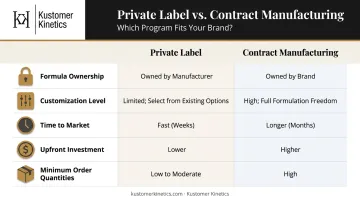
These figures are representative examples, not universal benchmarks. Actual timelines and MOQs vary by manufacturer and product type.
What Is Contract Manufacturing?
Contract manufacturing means partnering with a specialized facility to develop and produce a product built entirely to your specifications — covering formulation, testing, packaging, and quality standards.
Two distinct models exist within this category:
- CMO (Contract Manufacturing Organization): Produces your product using a formula you provide or co-develop
- CDMO (Contract Development and Manufacturing Organization): Also handles R&D and formulation development alongside production
The Core Benefit: Control
With contract manufacturing, you specify exact ingredients, concentrations, and delivery formats. For professional-grade topicals — where a physical therapist needs a specific viscosity in an ultrasound couplant, or a clinical recovery product requires a precise active-ingredient concentration — that level of control directly affects therapeutic outcomes.
The distinction matters because you own the formula — not just the label.
The Tradeoffs
The control comes at a cost. Development timelines run 12–20 weeks from concept to shelf, with phases covering concept, formulation, stability testing, packaging, and production. One manufacturer quotes custom formulation at roughly $10,000 in R&D plus $15,000–$25,000 in production costs — based on one manufacturer's published rates; actual costs vary by complexity and volume.
Where Contract Manufacturing Fits Best
Contract manufacturing makes sense for:
- Established or scaling brands that have validated product demand
- Brands entering retail channels where compliance documentation and differentiation are non-negotiable
- Clinical or pharmaceutical-adjacent topicals requiring evidence-based formulation
- Any brand that needs to own its formula as an intellectual property asset
What Is Private Label Manufacturing?
Private label means selecting a pre-developed, professionally tested formula from a manufacturer's existing catalog, then selling it under your own brand with custom packaging and labeling. "White label" is often used interchangeably, though white label typically implies even less customization — essentially the same generic product sold to many brands without modification.
With private label, the formula is already done. Stability testing has been completed. Production processes are established. You're not starting from zero.
The Core Benefit: Speed and Simplicity
Because the formula work is finished before you arrive, the path from concept to a shelf-ready branded product compresses dramatically. Private label manufacturing lead times run approximately 4–6 weeks, compared with 6–20 weeks for custom development. No R&D background required, no lengthy testing phases, no batch-validation cycles.
For a massage therapist or physical therapist who wants to offer branded recovery creams or ultrasound couplants to clients, that speed is the point. You focus on your practice; the manufacturer handles formulation quality.
The Key Limitation
Because the formula belongs to the manufacturer — and may be available to other brands — differentiating at the ingredient level isn't possible. Branding, packaging, positioning, and your professional reputation become your primary differentiators. That's a real constraint to weigh before choosing this path.
Where Private Label Fits Best
Private label works well for:
- Massage therapists, physical therapists, and estheticians adding a branded product to complement services
- Practitioners who want a new revenue stream without a large capital outlay
- Brands testing whether clients actually want to purchase a product before investing in custom development
- Anyone who needs a professional-grade formula without building one from scratch
Kustomer Kinetics manufactures private-label creams, gels, lotions, and ultrasound couplants — including Sonic Scan and Ultra Gel — for massage therapy, skincare, and clinical recovery applications. All products are made in Arcadia, CA, with full MSDS documentation available.
Which Model Is Right for Your Business?
A Practical Decision Framework
Choose private label if you are:
- A practitioner or emerging brand wanting to launch quickly with low startup costs
- Focused on client relationships and positioning rather than formulation development
- Testing whether demand exists before making a larger investment
- Working with a limited initial budget
Choose contract manufacturing if you:
- Have validated demand and a clear product vision requiring specific ingredients
- Plan to scale into retail or distribution channels
- Want formula ownership as a long-term IP asset
- Can support higher development costs and MOQs
The Transition Path
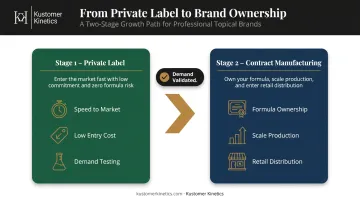
Many brands follow a natural progression: start with private label to prove client demand, then move to contract manufacturing once sales volume and brand identity justify the investment. Think of them as different stages of the same growth path, not competing philosophies.
Formula Ownership as a Long-Term Consideration
This is the one structural issue that often gets overlooked early. With a standard private-label arrangement, the manufacturer owns the formula. If they discontinue that product, you have nothing to take to a different production partner. With contract manufacturing — if formula ownership is properly negotiated in the contract — you can move production elsewhere without starting over.
For a first-time product launch, this risk is manageable. As your brand grows and that formula becomes central to your identity, it's worth revisiting.
A Real-World Scenario
Picture a physical therapy practice that wants to offer branded ultrasound couplant and recovery cream to patients. The practical starting point is private label: lower MOQs, no R&D cost, and a professionally vetted formula ready to go under their brand. The practice can test patient demand, build brand recognition, and start generating revenue — without a significant upfront commitment.
Once that practice is moving hundreds of units per month and wants an exclusive ingredient profile or proprietary formula no competitor can access, contract manufacturing becomes worth the investment. The transition makes sense at that point because the risk has been validated.
Conclusion
Contract manufacturing and private label serve different stages of business growth. For most practitioners entering the product space for the first time, private label is the faster, more practical path to a quality branded product — lower investment, shorter timelines, and no formulation expertise required.
Timing this decision correctly matters. Committing to contract manufacturing before demand is validated ties up capital unnecessarily. Launching with private label when you actually need a proprietary formula limits your ability to differentiate later.
The clearest decision trigger: if your brand depends on a formula no one else can replicate, contract manufacturing earns its complexity. If you need a quality, clinic-ready product under your label without reinventing the formulation, private label gets you there faster.
If you're a clinical practitioner ready to put your name on analgesic creams, ultrasound couplants, massage waxes, or rehabilitation topicals, Kustomer Kinetics manufactures private-label programs built for this space. Call 626-445-6161 or visit kustomerkinetics.com to discuss what a program looks like for your practice.
Frequently Asked Questions
What is the difference between contract manufacturing, private labeling, and custom formulation?
Private label uses an existing manufacturer formula sold under your brand name. Contract manufacturing builds a custom product to your specifications — covering formulation, testing, and production. Custom formulation refers specifically to developing a new ingredient formula from scratch and is typically the formulation phase within a contract manufacturing engagement.
What are the different types of private labels?
Three main categories exist:
- Standard private label: pre-made formula with custom branding applied
- Exclusive private label: formula developed for one brand but still owned by the manufacturer
- Specialty private label: pre-formulated to specific standards such as natural, vegan, clinical-grade, or professional-use
What are the different types of contract manufacturing?
Three main types exist:
- CMOs (Contract Manufacturing Organizations): produce finished product to your existing formula
- CDMOs (Contract Development and Manufacturing Organizations): also handle R&D and formulation development
- Toll manufacturing: the brand supplies raw materials; the manufacturer handles production only
Is private label or contract manufacturing better for small practices or clinics?
Private label is the stronger fit for small practices. Lower MOQs, no R&D investment, and faster launch timelines make it easier to test demand before committing to larger runs. Contract manufacturing becomes worth considering once volume and differentiation needs justify the higher upfront cost.
Do you own the formula with private label manufacturing?
In standard private label arrangements, the manufacturer retains formula ownership, meaning the same formulation may be available to multiple brands. Some manufacturers offer exclusive or semi-exclusive agreements. Full formula ownership typically requires a contract manufacturing arrangement with ownership terms negotiated explicitly in the contract.
How long does it take to launch a private label product compared to contract manufacturing?
Private label products can typically be ready in 4–6 weeks, since formulas are pre-developed and production-ready. Expect 12–20 weeks for contract manufacturing, where custom formulation development, stability testing, and batch validation all add lead time.