Introduction: What Is a Topical Anesthetic Gel SDS and Why Does It Matter?
Working with topical anesthetic gels professionally means taking ownership of the chemical products in your workspace. That includes knowing where to find hazard information, how to respond to accidental exposure, and what OSHA requires of you.
A Safety Data Sheet (SDS) is a standardized document covering a product's chemical composition, hazard classifications, safe handling procedures, storage requirements, and emergency response protocols.
Under OSHA's Hazard Communication Standard (29 CFR 1910.1200), maintaining accessible SDS records is a compliance requirement for any facility with employees — not a best practice.
If you're a massage therapist, esthetician, physical therapy clinic, or clinical recovery practitioner who handles these products regularly, this guide gives you everything you need to stay compliant and prepared:
- The difference between MSDS and SDS terminology
- How to read all 16 SDS sections for a topical anesthetic product
- Ingredient-specific hazard data for common anesthetic agents
- Safe handling, storage, and disposal practices
- OSHA compliance obligations for clinical and spa settings
Key Takeaways
- SDS has replaced MSDS since OSHA's June 2015 compliance deadline — the format is now standardized across 16 sections
- Sections 1–8 cover daily operational needs; Sections 9–16 become critical during incidents and regulatory inspections
- Benzocaine carries a documented methemoglobinemia risk; all amide-class anesthetics carry systemic absorption warnings
- Every clinical facility with employees must maintain accessible SDS records and train staff on how to use them
- Request the SDS from your supplier before stocking any new topical anesthetic
MSDS vs. SDS: Understanding the Terminology Shift
Many practitioners still encounter the term "MSDS" — Material Safety Data Sheet — on older product documentation. That term is now outdated.
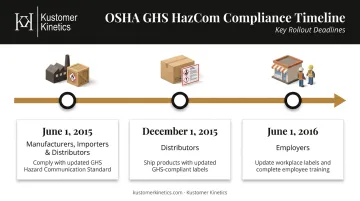
In 2012, OSHA revised its Hazard Communication Standard to align with the United Nations Globally Harmonized System (GHS) of Classification and Labelling of Chemicals. The revised standard introduced the current "SDS" terminology and, more importantly, a mandatory 16-section format. The compliance deadlines:
- June 1, 2015 — Manufacturers, importers, and distributors required to comply with the updated format
- December 1, 2015 — Final deadline for distributors to ship updated labels
- June 1, 2016 — Employers required to update workplace labels, HazCom programs, and training
Old MSDS documents had no standardized section order — format varied by manufacturer. The current OSHA Appendix D SDS standard mandates a specific 16-section structure, making it far easier to locate safety information across different products and suppliers.
If you still have documents labeled "MSDS" from older product batches or legacy suppliers, treat them as equivalent in content — but cross-reference them against the current 16-section structure to confirm nothing is missing. Manufacturers like Kustomer Kinetics provide SDS documentation with their professional topical products; contact them directly at 626-445-6161 to request current documentation for any product in their line.
Key Active Ingredients in Topical Anesthetic Gel and What the SDS Says About Them
Common Active Agents and Their GHS Classifications
Most professional topical anesthetic gels contain one or more of the following active ingredients. Each carries distinct hazard classifications that appear in SDS Section 2 (Hazard Identification) and Section 3 (Composition/Information on Ingredients):
| Ingredient | GHS Signal Word | Key Hazard Statements |
|---|---|---|
| Lidocaine | Warning | H302 — Harmful if swallowed; irritant |
| Benzocaine | Danger | H317 (Skin Sens. 1), H370 (STOT SE 1), H411 (Aquatic Chronic 2) |
| Prilocaine | Warning | Irritant; methemoglobinemia association via metabolite ortho-toluidine |
| Tetracaine | Danger | H301 (Acute Tox. 3), H317 (Skin Sens. 1), H351 (Carc. 2) |
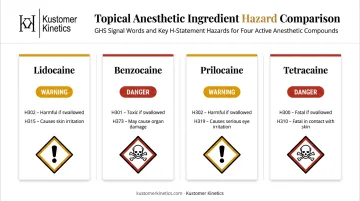
Benzocaine deserves particular attention. The FDA's May 2018 safety communication documented more than 400 U.S. cases of benzocaine-associated methemoglobinemia since 1971, including 4 deaths. While that data primarily concerns OTC oral health products, it underscores why benzocaine's SDS hazard classification warrants careful review in any professional setting.
Ester-class agents like benzocaine carry methemoglobinemia risk; for amide-class anesthetics — lidocaine and prilocaine — the more relevant clinical concern is systemic absorption. DailyMed labeling for lidocaine/prilocaine formulations confirms that absorption depends on application area, duration, and skin condition. This becomes clinically relevant when applying to large surface areas or compromised skin.
Concentration Thresholds and Section 3 Disclosure
The SDS won't list every ingredient — only those above applicable cutoff concentrations or those that present a health risk even below those thresholds. Under OSHA HazCom, health-hazard components at 1% or greater and carcinogens at 0.1% or greater typically trigger disclosure. Lower concentrations must also be reported when a health risk exists at that level.
Kustomer Kinetics' Lido-Gel Topical Anesthetic Hydrogel, for instance, contains 4% lidocaine as its active ingredient — well above standard disclosure thresholds and clearly listed in its formulation documentation.
Inactive Ingredients Also Appear in Section 3
Carbomers, preservatives, and fragrances used as excipients can carry their own hazard classifications and will appear in Section 3. Before stocking a new product, cross-reference Section 3 excipients against any known client sensitivities or contraindications documented in your intake forms.
How to Read the 16 Sections of a Topical Anesthetic Gel SDS
OSHA's SDS brief notes that Sections 1–8 contain the most operationally relevant information for workers — identification, hazards, safe handling, and emergency controls. Sections 9–16 become critical during incidents, inspections, or staff training.
Sections Most Relevant to Daily Clinical Use (Sections 1–8)
Here's what each group covers and why it matters for your practice.
Section 1 — Identification Lists the product name, intended use, manufacturer contact, and emergency phone number. Always verify that what's printed here matches your actual product label. Discrepancies can indicate an outdated SDS or a formulation change.
Sections 2 and 3 — Hazard Identification and Composition
- Section 2 shows GHS hazard pictograms, signal words (Danger vs. Warning), and H-statements. Professional topical anesthetic gels typically fall into the low-to-moderate hazard range for routine skin contact, though concentrated formulations or those containing benzocaine or tetracaine warrant closer attention.
- Section 3 lists all active and hazardous ingredients above applicable thresholds.
Sections 4–6 — First Aid, Fire-Fighting, and Accidental Release
- Section 4: First aid protocols for skin contact, eye contact, ingestion, and inhalation. For eye contact, NIOSH guidance requires flushing with large amounts of water for at least 15 minutes and seeking medical attention promptly
- Section 5: Relevant if the product contains alcohol or flammable solvents; review the listed extinguishing media
- Section 6: Spill cleanup procedures for gel products, typically involving containment, absorption with inert material, and disposal per local regulations
Sections 7 and 8 — Handling/Storage and Exposure Controls/PPE
Section 7 specifies storage conditions: typically cool, dry, away from direct sunlight and heat, in original sealed containers.
Section 8 outlines PPE requirements. OSHA's hand protection standard (29 CFR 1910.138) requires glove selection based on actual hazards and exposure duration. Your product's SDS will specify the appropriate glove type — don't assume nitrile is universally required; verify against the specific SDS.
Sections for Compliance and Emergency Reference (Sections 9–16)
These sections matter most when something goes wrong or when a regulatory inspector arrives:
- Section 9 — Physical and chemical properties (pH, flash point, appearance)
- Section 10 — Stability and reactivity; incompatible materials
- Section 11 — Toxicological data; routes of exposure, acute and chronic effects
- Section 13 — Disposal considerations (note: OSHA designates this as non-mandatory, but it's practically essential for pharmaceutical-containing products)
- Section 15 — Regulatory classifications (also non-mandatory under OSHA, but critical for California facilities under Cal/OSHA Title 8 CCR 5194)
Safe Handling, Storage, and Disposal for Clinical Settings
Handling Best Practices
- Use appropriate hand protection per the product SDS — verify glove compatibility with the specific formulation
- Avoid applying near eyes unless the product is specifically formulated for periorbital use (Kustomer Kinetics' Lido Gel family is restricted to general external skin application only)
- Limit application to surface areas consistent with SDS toxicological guidance, particularly for products containing benzocaine or prilocaine
- Keep the SDS physically accessible in the treatment area — not filed away in an office
Storage Requirements
SDS Section 7 typically specifies:
- Cool, dry location away from direct heat and sunlight
- Original sealed containers only
- Away from incompatible materials noted in Section 10
Improper storage can degrade anesthetic ingredients, reducing efficacy and altering the product's chemical profile. Follow your product's SDS temperature guidance specifically, not general assumptions.
Correct storage also sets the stage for proper end-of-life handling — which carries its own regulatory weight.
Disposal Requirements
Topical anesthetic gels with active pharmaceutical ingredients require careful disposal. Key regulatory points:
- EPA's sewer ban (effective August 21, 2019) prohibits healthcare facilities from disposing of hazardous waste pharmaceuticals down the drain
- Products meeting the definition of hazardous waste pharmaceuticals under 40 CFR Part 266 Subpart P cannot go in regular trash or down drains
- California facilities have additional obligations under DTSC pharmaceutical waste guidance
Always consult your specific product's SDS Section 13 and check with your local waste management authority for current disposal requirements.
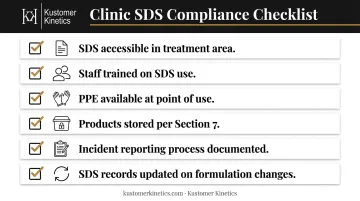
Clinic Compliance Checklist
- ☐ Current SDS accessible in the treatment area for every topical anesthetic product in use
- ☐ Staff trained on how to read and use the SDS
- ☐ Appropriate PPE (per SDS Section 8) available at point of use
- ☐ Products stored per SDS Section 7 requirements
- ☐ Incident reporting process documented and communicated to staff
- ☐ SDS records updated when product formulations change
OSHA Compliance and SDS Requirements for Practitioners
Who Is Covered
Under 29 CFR 1910.1200, employers must:
- Maintain a current SDS for every hazardous chemical in the workplace
- Keep SDS records readily accessible to employees during every work shift
- Provide training on how to read and use labels and SDSs
This applies directly to therapy clinics, medical spas, chiropractic offices, and physical therapy centers that employ staff who handle topical anesthetic gels. Self-employed sole proprietors with no employees fall outside OSHA's scope, but maintaining SDS records still protects you from liability exposure. California facilities face an additional compliance layer under Cal/OSHA Title 8 CCR 5194, which mirrors federal HazCom requirements with state-specific enforcement.
How to Obtain and Maintain SDS Records
- Request the SDS directly from your manufacturer or supplier at the time of purchase, before stocking any new topical anesthetic product
- Store both physical and digital copies in accessible locations, not locked filing cabinets or archived folders staff can't quickly reach
- Update records whenever you receive a new product formulation or your supplier notifies you of changes
Kustomer Kinetics provides SDS documentation via direct download at kustomerkinetics.com; additional product documentation is available by calling 626-445-6161.
Frequently Asked Questions
What is the difference between an MSDS and an SDS for topical anesthetic gel?
MSDS is the older format with no standardized structure — section order varied by manufacturer. SDS is the current GHS-compliant 16-section format required under OSHA's updated Hazard Communication Standard since 2015. Both convey the same safety information, but the SDS format is standardized and much easier to navigate.
Is topical anesthetic gel considered a hazardous chemical under OSHA regulations?
Classification depends on formulation. Gels containing lidocaine, benzocaine, or tetracaine typically meet OSHA's hazard criteria and require an SDS. Hazard levels for professional external-use products are generally low to moderate, but the classification still triggers HazCom compliance obligations.
What should I do if topical anesthetic gel contacts someone's eyes?
Follow SDS Section 4 first aid guidance: immediately flush the eye with large amounts of water for at least 15 minutes, lifting the eyelid occasionally, then seek medical attention. Keep the SDS physically accessible in every treatment area so this guidance is within reach when it matters.
How should topical anesthetic gel be stored according to its SDS?
SDS Section 7 typically specifies storage in a cool, dry location away from heat sources and direct sunlight, in original sealed containers. Improper storage can degrade active ingredients, reduce product efficacy, and potentially alter the chemical profile of the formulation.
What active ingredients in topical anesthetic gels have the most significant hazard classifications?
Benzocaine carries the most documented risk; the FDA has linked it to methemoglobinemia, including fatalities, at high concentrations. Tetracaine carries a Danger signal word with acute toxicity and suspected carcinogen classifications. Amide-class anesthetics like lidocaine and prilocaine carry systemic absorption warnings detailed in their SDS toxicology sections.
How do I get the SDS for a topical anesthetic gel product I purchased?
Request it directly from your manufacturer or supplier at the time of purchase. Reputable professional-grade suppliers are required to provide it and should have current documentation readily available. For Kustomer Kinetics products, SDS documents are downloadable at kustomerkinetics.com or available by calling 626-445-6161 during business hours.